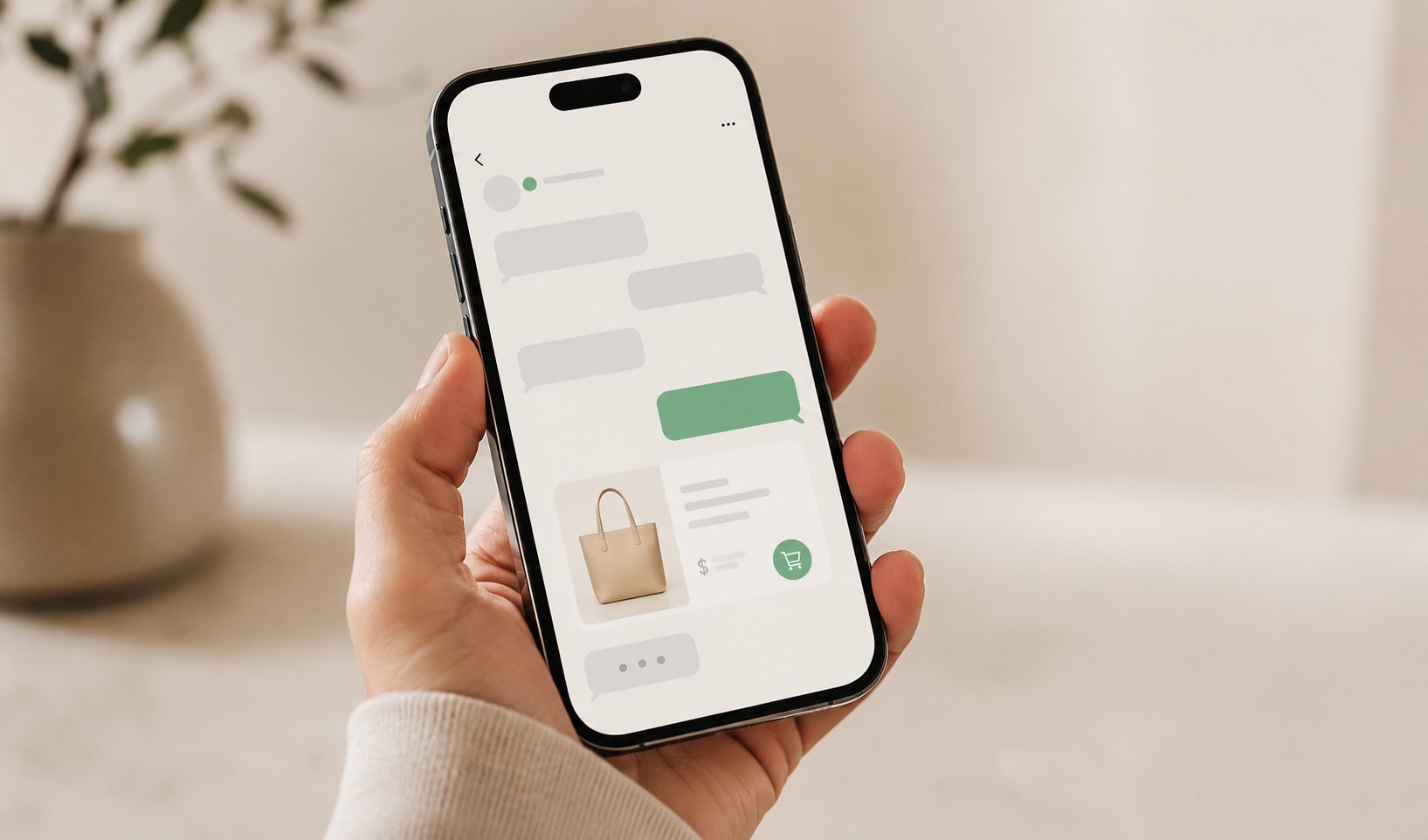

Online stores have quietly removed something every physical shop still has: a person to talk to. When a shopper hesitates on a product page, has a sizing question, or isn't sure which item fits their needs, there's no one there — just a search bar and a hope that the FAQ page covers it. An AI shopping assistant puts that person back. It's a conversational layer, powered by AI, that talks to visitors in real time, understands your catalog, and helps them decide — the way a good salesperson would on the shop floor.
This guide covers what AI shopping assistants are, why the category exists now, the benefits, the different types on the market, how to implement one, and where the space is heading.
What Is an AI Shopping Assistant?
An AI shopping assistant is software — usually voice or text-based — embedded directly into an online store that can hold a real conversation with a visitor about the products on sale. Unlike a search bar, it understands intent ("something for dry skin under $30") rather than just keywords. Unlike a static FAQ, it can follow up, ask clarifying questions, and recommend specific products from the actual catalog.
Three things separate it from older tools:
It understands natural language, not menu trees or scripted flows.
It knows the store's catalog, so recommendations are grounded in real, in-stock products rather than generic answers.
It's available on every page, at any hour, without a human behind it.
The result is closer to a knowledgeable in-store salesperson than to the chatbots most shoppers learned to ignore a few years ago.
Why This Category Emerged
E-commerce scaled by removing the salesperson. A physical boutique has someone greeting customers, answering questions, and gently guiding a hesitant buyer toward a decision. A typical online store has none of that — just product pages and a search box. That trade-off worked while e-commerce was growing on convenience and price. It stopped working once shoppers expected the same guidance online that they get in person.
Two forces pushed AI shopping assistants from novelty to necessity:
Rising customer expectations. Shoppers now expect stores to answer questions instantly, the same way they'd ask a friend. A visitor who has to dig through a FAQ page or wait for an email reply is a visitor who often just leaves.
Mature conversational AI. Large language models finally reached a point where they can hold a genuinely useful, on-brand conversation about a real product catalog — not a scripted decision tree, but an actual back-and-forth that adapts to what the shopper says. Amazon's Rufus is the clearest proof this shift is real at scale: see the actual numbers behind it.
Put together, the gap between "what shoppers expect" and "what a typical store offers" became wide enough that a new category of tool had to fill it.
The Benefits of an AI Shopping Assistant
It captures the sales a store didn't know it was losing
Standard analytics (Google Analytics, Shopify's own dashboard) show where visitors went and when they left — not why. An AI shopping assistant sits in the middle of the actual conversation, so it captures the hesitation itself: the size question nobody answered, the ingredient concern that never got resolved, the shipping doubt that ended the session. That's information no click-tracking tool can give you. See what implementation actually captures →
It rescues sales in progress, not just discovery traffic
There are two distinct moments an assistant can step in. In a rescued sale, a visitor is already on a product page with a specific doubt — the assistant resolves it before they bounce. In a discovery sale, a visitor is browsing with no fixed target — the assistant asks a couple of questions and guides them to the right product. Tracking these separately matters, because they represent two different failure points in a typical funnel, and fixing one doesn't fix the other.
It works around the clock, in any language
A single merchant, or even a small support team, can't staff live chat 24/7 across time zones. An AI assistant can hold the same quality conversation at 3am as it does at 3pm, and — depending on the tool — do it in the shopper's own language without extra setup.
It reduces repetitive support load
Questions like "does this run small," "is this in stock," or "what's your return policy" are asked constantly and rarely need a human. An assistant that knows the catalog and store policies can resolve these instantly, freeing the merchant (often a solo founder or a two-person team) to focus on the questions that actually need a human.
It captures the loss that never shows up in analytics
When a visitor leaves a product page without buying, most merchants only count one loss: the sale. But there's a second, quieter loss — the reason they left. In a physical store, a salesperson would hear that reason directly, and hearing it a hundred times over a season becomes real knowledge: which objections are genuine, which product descriptions confuse people, what to fix before the next customer hits the same wall. A silent storefront never collects that knowledge — it only sees the bounce.
An AI shopping assistant is what lets a store hear that second loss again. Tools built specifically for this — like SellerTwin — go a step further by surfacing recurring objections directly back to the merchant (a feature sometimes called Coach Mode), turning scattered conversations into a running list of what's actually confusing or blocking customers, without the merchant having to read every transcript.
It turns conversations into a data asset
Every conversation is a signal: which objections come up repeatedly, which products get the most questions, which explanations actually move someone toward a purchase. Over time, this becomes a feedback loop most stores never had access to before — a real record of why people buy or don't, not just whether they did. Examples of this in practice →
Types of AI Shopping Assistants
Not all AI shopping assistants work the same way. Broadly, they fall into a few categories:
Text chat assistants — the most common form, a chat widget on the storefront that handles typed questions. Familiar, low-friction, but limited to shoppers willing to type.
Voice-enabled assistants — allow a shopper to simply talk, the way they would to a salesperson. Lower friction for many shoppers, especially on mobile, but requires more sophisticated real-time voice technology to feel natural.
Recommendation-first assistants — focused primarily on suggesting products based on stated preferences, closer to a smart filter with a conversational interface than a full salesperson.
Full conversational sellers — designed to replicate an actual salesperson: they can discuss the brand, handle objections, recommend complementary products, and guide a shopper from browsing to checkout in one continuous conversation, in either voice or text.
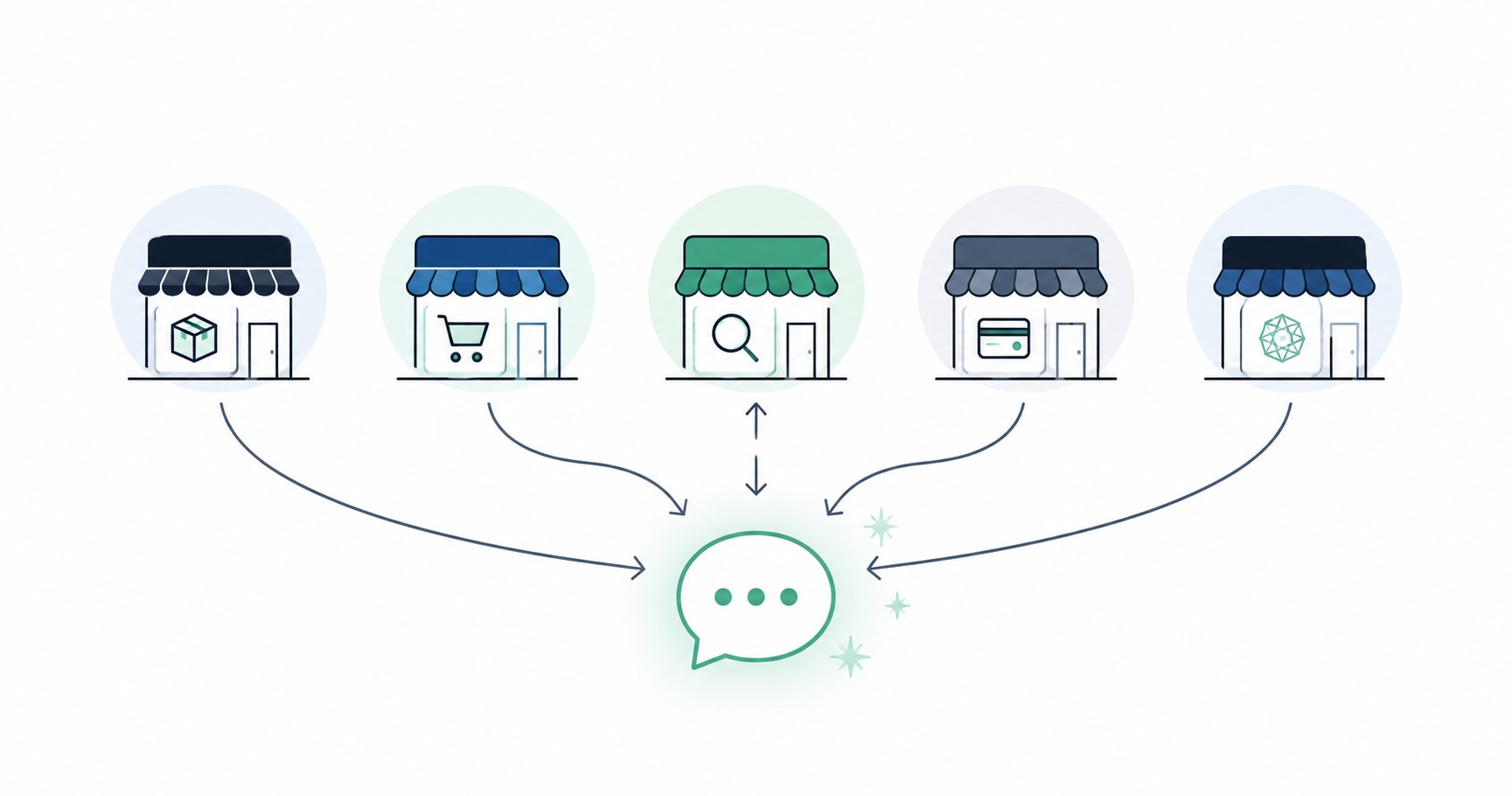
Platform-specific implementations also differ — an assistant built for Shopify can plug directly into product data, inventory, and checkout, while a WooCommerce setup depends more on how the store's data is structured.
How to Implement an AI Shopping Assistant
Setting one up generally follows the same sequence, regardless of the platform:
Connect the catalog. The assistant needs access to real product data — names, descriptions, prices, stock levels, images — usually via a CSV import, a platform integration (like a Shopify connector), or an API.
Define the personality and boundaries. A good assistant sounds like the brand, not like a generic bot. This usually means writing a short brand voice guide: how formal or casual, what to emphasize, what never to say (fabricated discounts, unavailable guarantees, etc.).
Add an embeddable widget or link. Most tools give a single script tag or a magic link that can be dropped onto any storefront, regardless of the underlying platform.
Handle edge cases deliberately. What happens when a product is out of stock? When a shopper asks something outside the catalog? When they seem ready to buy? These rules make the difference between a natural conversation and an awkward one.
Review real conversations regularly. The fastest way to improve an assistant is to read what it's actually being asked — recurring objections, confusing product descriptions, missing FAQs — and fix the underlying gaps.
Full setup usually takes under an hour for a small catalog; the ongoing tuning based on real conversations is what separates a mediocre assistant from a genuinely useful one.
AI Shopping Assistant Pricing
Pricing in this category is typically usage-based, tied to conversation volume or minutes of voice interaction, layered on top of a base subscription tier. Free or low-cost tiers usually cap the number of products, conversation minutes, or monthly sessions, with paid tiers unlocking higher volume, more products, and advanced features like analytics or multi-language support. Because voice interaction has a real compute cost, it's usually priced separately from text-only usage.
Measuring ROI
The core question for any merchant considering an AI shopping assistant is simple: does it pay for itself? The honest answer depends on what's being measured. Direct attribution — tracking whether a specific conversation led to a specific purchase — is the clearest signal, but it only tells part of the story. The harder-to-quantify value is in the sales that don't show up as an assistant-attributed purchase but wouldn't have happened otherwise: the visitor whose hesitation got resolved, then bought a day later after comparing options elsewhere.
A reasonable approach is to track three things together: conversion rate on sessions where the assistant was used versus sessions where it wasn't, average order value in assisted sessions, and the volume of recurring objections it surfaces (which point to fixable issues elsewhere on the site, independent of the assistant itself).
Case Studies
Independent brands and small e-commerce teams tend to see the clearest impact, since they're the ones least likely to have live chat staffing or a dedicated support team in the first place. The pattern that shows up most consistently: stores don't just gain a few extra conversions, they gain visibility into why visitors weren't converting before — information that used to be invisible. Read specific examples →
Trends to Watch
Voice is becoming the default, not the exception. As real-time voice AI gets cheaper and more natural-sounding, more assistants are shifting from text-first to voice-first experiences, especially on mobile.
Assistants are becoming a data layer, not just a support tool. The conversations themselves are increasingly treated as a source of product and customer intelligence — feeding back into catalog decisions, marketing angles, and even product development.
Platform-native integrations are deepening. Rather than a bolt-on widget, assistants are increasingly built to sit natively inside platforms like Shopify, with direct access to inventory, checkout, and order data rather than a loosely connected script.
Multilingual commerce is becoming table stakes. Stores selling internationally increasingly expect an assistant to handle a conversation in the shopper's language automatically, without separate setup per market.
Big tech is validating the category. Amazon, Walmart, Google, Klarna, and Perplexity have all launched their own AI shopping assistants within months of each other — proof this isn't a niche experiment but the direction the entire industry is moving. See what's behind the race →
Frequently Asked Questions
What is an AI shopping assistant? Software embedded in an online store — through chat or voice — that holds real conversations with shoppers, understands the store's catalog, and helps visitors find and choose products, similar to how a salesperson would in person.
How is an AI shopping assistant different from a chatbot? Traditional chatbots follow scripted decision trees and struggle outside their programmed paths. AI shopping assistants use natural language understanding and real catalog data to hold open-ended, context-aware conversations. Full comparison →
How do AI shopping assistants personalize the experience in real time? By combining what a shopper says in the conversation (stated preferences, questions, objections) with live catalog data (stock, price, attributes) to adjust recommendations as the conversation unfolds, rather than showing a fixed set of suggestions.
Do I need Shopify to use an AI shopping assistant? No — most tools support any platform through a catalog import or an embeddable widget, though native integrations (like with Shopify) tend to offer deeper functionality out of the box.
How do AI shopping assistants recommend products? By matching what the shopper describes against the store's actual product data, using similarity and relevance scoring rather than a fixed set of manually programmed rules — so recommendations stay grounded in real, in-stock products.
Is implementation difficult for a small store? Not usually. Most of the setup work is connecting the catalog and defining the brand voice; both can typically be done in under an hour for a small to mid-sized catalog.
Most AI shopping assistants built for independent stores are still text-only. Voice — a shopper simply talking, the way they would to someone on the shop floor — remains rare outside a handful of tools, SellerTwin among them. If you're weighing whether your store needs one, that's the gap worth checking first: can it actually talk back?
Your store could have a salesperson too. See how it works →